The Academy of Theatrical Combat ~ COMMON FACTORS OF PERFORMANCE FIGHTS ~ |
| A
performance fight is not a fight. It is not a competition. It is more akin
to a dance (though generally not dance-like in presentation) and is above
all a cooperation between the individuals involved,
each providing an essential element to the performance. There is no winner
or loser, but rather two (or more) people working together towards a common
goal: the creation of an intense and exciting moment of drama. This goal
is best accomplished when cooperation is coupled with the technical expertise
and choreography that is logical within the context of the piece.
This cooperation is essential whether the fight is performed with bare hands or the most exotic weapons imaginable. There can be no translation of real anger or fighting fervor into the techniques. Everything must be meticulously rehearsed to allow the performers to give their all to each action or reaction. Ego, pettiness and establishing adversarial relationships are the quickest ways to destroy a good fight scene. Some other factors common to all fight scenes are timing, distance, cueing and reversal of tension. Distance, is both the distance between the performers as well as the distance between one person and the final position of the weapon (sword, fist, etc.) in its strike. Timing incorporates both the speed at which the actions are performed as well as the action-reaction speed of the intrinsic partnered movements. Together, these are the two most important factors for safety and the "reality" of fight scenes. It may seem simplistic, but if your distance is always correct, and your timing always on, then your moves will be reasonably safe and generally believable - the qualifications come from the fact that the unforeseen can still happen, and that certain moves require more elements for believability, such as attention to angles or the sound of a hit (the knap.) Cueing is the technique that alerts your partner that a specific, planned action is about to occur, so that their reaction can be timed properly. Even moves that flow one into the other could be said to be cued by the previous move or the "flow of the action." One of the most common cues is the eye cue, which is a quick flash of eye contact before the move. The eyes should look to the target on the attack and maintain a logical scan between attacks. They should never fixate on one spot as this is quite dangerous. The eye cue differs from the visual cue, which is showing or slightly telegraphing what is about to occur, as in pulling back and raising a weapon before making a wild swing (a swipe.) Other common types of cues are the touch cue - a quick physical contact before an action, generally with a hand - and vocal cues and timing cues, both of which are self-explanatory. Needless to say, often several of these cues are used simultaneously. Reversal of tension is the technique to make actions look as if they are being done with full force, but in reality are carefully controlled. There are many different ways to do this, but in general it involves using the muscles strongly in almost exactly the opposite of what seems to be going on. For example, a cut with a broadsword is controlled by wringing the hands together on the sword handle as if wringing out a towel. This tenses the muscles in opposition to the action, making it look very forceful, but actually stopping the force of the cut. Another example: in a double handed strangle. Rather than pressing on the throat, the attacker’s hands actually tense and pull away from the neck and the partner being strangled controls the action by holding the attacker’s hands down in place, giving a realistic look of desperate muscular engagement. Every style of fighting and every weapon has its own specific way of using these common factors, which are discussed in detail in other sections of this book. However, the general principles of their use remain the same. No fight scene can be consistently or safely performed without adherence to the common factors of distance, timing, cueing, reversal of tension and above all the principle of cooperation that must be present to create partnered actions and turn them into exciting and believable fight sequences.
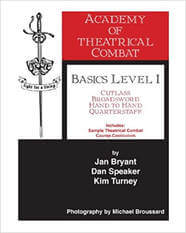
Taken from the Academy of Theatrical Combat's Handbook of Techniques by Dan Speaker Home | Swordmasters
| Gallery | Training
| Theatrical Combat | Performance
Fighting | Members
Contact Us | Links |What's New! Questions or comments? Email info@theatricalcombat.com © 2006 The Academy of Theatrical Combat |